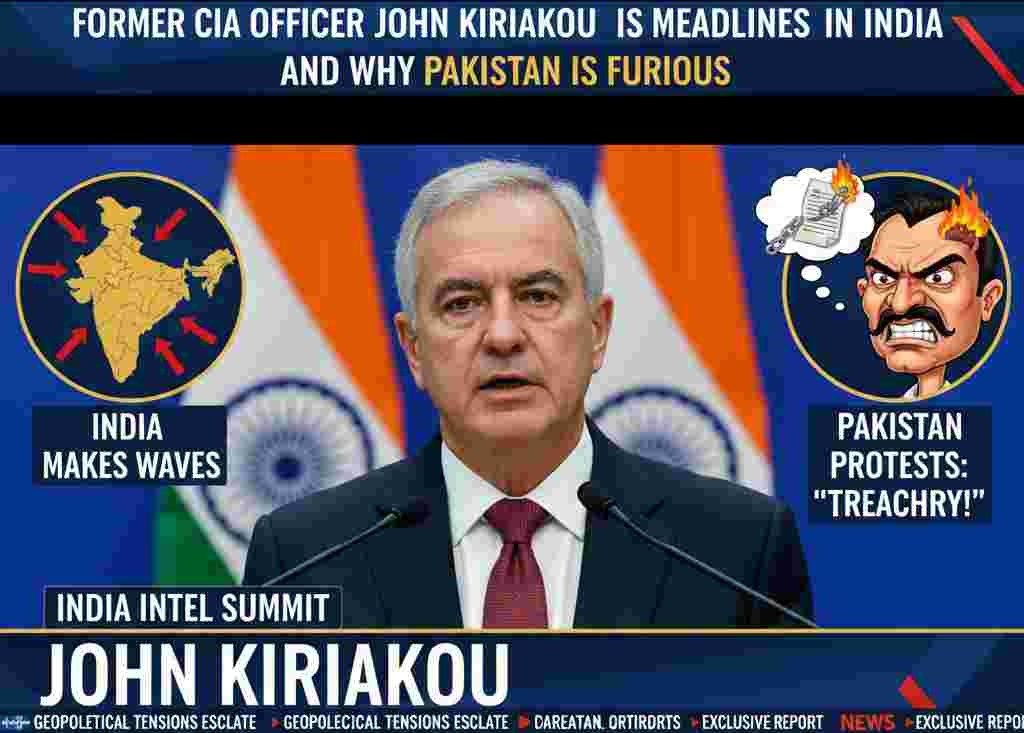
Former CIA officer John Kiriakou sparks major controversy after stating India would win a conventional war against Pakistan.
Why Former CIA Legend John Kiriakou Says India Would Defeat Pakistan—And Why Pakistan Is Outraged
In today’s world, the battle between India and Pakistan isn’t only fought on borders—it’s fought in narratives, influence, and information warfare. And now, this information war has taken a fiery turn after a major statement from legendary former CIA officer John Kiriakou, whose comments have shaken Pakistan’s political and military establishment.
This story has gone viral across international media, and at affairstime.com, we break down exactly what happened—and why it matters for India, Pakistan, and global geopolitics.
Who Is John Kiriakou and Why Is He So Influential?
John Kiriakou is not your average intelligence officer. He is widely considered a legend in the intelligence community for several reasons:
- Former CIA officer with a critical role in anti-terrorism operations.
- Played a key role in dismantling major terrorist networks.
- Exposed CIA’s extreme interrogation and torture practices, including waterboarding.
- Served 30 months in prison for speaking out against his own agency—cementing his reputation as a man who stands for truth.
- Author of multiple books on CIA operations, Middle East geopolitics, and espionage.
- One of the most respected geopolitical analysts today.
His credibility is exactly why his recent comments have attracted huge attention worldwide.
The Statement That Sparked a Storm
In a recent discussion, Kiriakou said something Pakistan did not want to hear:
In a conventional, non-nuclear war, India would easily defeat Pakistan.
He explained this through simple logic:
- India’s population is five times larger.
- India’s military, economy, and overall capability are significantly stronger.
- In any non-nuclear battlefield scenario, Pakistan would be unable to match India’s scale.
This wasn’t an emotional claim—it was a strategic assessment from someone who worked at the highest levels of intelligence.
Pakistan’s Reaction: Threats, Pressure, and Intimidation
After his statement went public, Pakistan’s response was extreme—even by geopolitical standards.
According to Kiriakou:
- He received multiple death threats.
- Members of former PM Imran Khan’s party allegedly sent him a letter demanding an apology.
- They questioned how he could claim that India could defeat Pakistan.
- Some threatened legal action if he didn’t retract his statement.
Kiriakou’s answer?
He said he threw their letter in the trash—like “waste paper.”
This bold reaction only intensified the media storm around him.
Pakistan’s History of Threatening Analysts
Kiriakou’s experience is not an isolated case. Many global defense and geopolitical analysts have claimed similar intimidation from Pakistan whenever they express views favoring India.
Whether it’s:
- Indian Air Force capabilities
- Rafale deal analysis
- India’s counter-terrorism operations
- India–Pakistan war scenarios
- Kashmir security assessments
Several analysts have privately admitted receiving threats or pressure from Pakistan-linked groups.
This raises a bigger question:
How far does Pakistan go to control global narratives?
Kiriakou’s Explosive Claims on Pakistan’s Nuclear Weapons
This story goes beyond India and Pakistan.
Kiriakou repeated a controversial claim made by many geopolitical experts:
Since the early 2000s, the United States—specifically the Pentagon—has had influence over Pakistan’s nuclear arsenal.
He also said:
- A.Q. Khan, considered the father of Pakistan’s nuclear program, was targeted by U.S. intelligence.
- Saudi influence later stepped in to protect him.
- This aligns with the deep Saudi–Pakistan defense partnership we see today.
These claims, if true, reveal a massive layer of geopolitical control behind Pakistan’s nuclear program.
Israel, Trump, and Iran—Another Bombshell Claim
Kiriakou also shared a major Middle East revelation:
According to his sources:
- Israel allegedly threatened former U.S. President Donald Trump to bomb Iran immediately,
or Israel might consider using nuclear weapons against Iran.
This pressure, Kiriakou says, pushed Trump to order airstrikes on Iran’s nuclear facilities.
Statements like these are why Kiriakou’s words carry global weight—and why his comments spark such widespread reactions.
Why This Story Matters for India
This incident highlights a critical reality:
India must actively fight narrative and information warfare.
Because:
- Pakistan uses large-scale online propaganda.
- Experts who support India are often threatened or silenced.
- Geopolitical influence is shaped as much by perception as by power.
India may need to consider:
- Supporting independent analysts
- Providing protection or backing to credible voices
- Encouraging transparent and fact-based discussions
- Countering misinformation more aggressively
As affairstime.com often reports, geopolitical warfare today isn’t just fought with weapons—it’s fought with messaging.
What Happens Next?
This issue is far from over.
With Kiriakou’s immense credibility and fearless approach, more analysts from the U.S. and Europe may soon come forward to reveal:
- Similar threats they received
- Deeper insights into Pakistan’s influence networks
- Hidden geopolitical pressure tactics
And as these voices grow, the global narrative around India and Pakistan may begin to shift in ways Pakistan can no longer control.
Keep watching affairstime.com for the latest developments—we’ll continue bringing you in-depth geopolitical insights as this story evolves.